


Governance
Effective governance is central to the success of this Strategy, grounded in Aboriginal leadership and accountability to Communities. In line with Priority Reform 1: Formal partnerships and shared decision making, specifically the “strong partnership elements” defined in Clauses 32 and 33 of the National Agreement on Closing the Gap, the governance structure for this Strategy is built on the principles of self-determination, shared decision-making and Aboriginal-informed accountability, ensuring Aboriginal people shape the processes and decisions that affect their children and families.
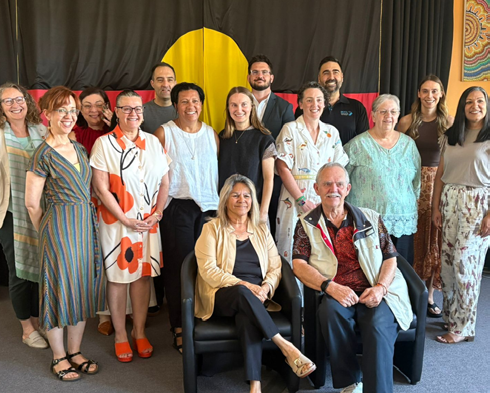
Image: ACGG meeting6
Aboriginal Co-design Governance Group (ACGG)
ACGG is the primary shared decision-making body for this Strategy. It is currently a co-chaired governance group between the South Australian Aboriginal Community Controlled Organisation Network and OECD.
Membership: The ACGG has equal government and non-government membership, with majority Aboriginal representation, and includes early education and child development experts, representatives from ACCOs, SAACCON, the education peak SAAETCC, Wakwakurna Kanyini - the peak body for Aboriginal Children and Families, Community Elders as First Teachers and government agencies.
Role: The ACGG exists to uphold and advance the principles of co-design in early childhood policy and practice. Its primary purpose is to ensure that Aboriginal voices, Cultural authority, and lived experience shape the development and implementation of initiatives that impact Aboriginal children, families, and Communities. Through its leadership, the group promotes Culturally safe, Community-led approaches that reflect the aspirations of Aboriginal South Australians.
Ongoing Community engagement and local voice
Beyond ACGG, OECD is committed to deep, ongoing engagement at the local, regional and remote levels. This Strategy was built on extensive, Aboriginal-led place-based engagements across South Australia’s 6 First Nations Voice to Parliament regions. This commitment to listening to and collaborating with Communities will continue.
The Strategy implementation will require work with local Communities and leaders, ACCOs and Aboriginal peaks to co-design and implement programs that are responsive to local priorities, needs and Cultural contexts. Prioritisation will be given to ACCOs and Aboriginal businesses for the design and implementation of initiatives.
South Australian First Nations Voice to Parliament
Consistent with the Government of South Australia’s commitment to listening to Aboriginal voices, the First Nations Voice will play a crucial role in informing the transformation of the sector to respond to the needs of Aboriginal children and families. Engagement with the First Nations Voice to Parliament will continue during the co-design process of implementing and evaluating the Strategy.
6 Image: Members at the December 2025 ACGG meeting, also attended by MTL Consulting Services and Kimberley Wanganeen Consultancy.